Sometimes a good metaphor goes a long way. I found this reminder useful when my now 9 year old daughter came home from her kindergarten several years ago and told me that a little boy in her room was the best at everything, and the fastest reader. In fact, his teacher gave him a “prize” for these skills, and she witnessed this adult affirmation of his speed and perfection. Time for a good lesson, so I pulled out a metaphor I have found useful when talking with very young children about development and reading. I told her that learning to read is opening a door, on the other side are a lot of incredible things worth learning about, but different people open that reading door in different ways. Some are cautious, slow and steady, making sure that the door does not creak as it opens, checking all the time to understand how the door works, exactly; they might peek around the edge so they are not too surprised at what they find on the other side, some even need to build strength in their hands in order to turn the knob. Others are fearless, and barrel right through the door, and they are, suddenly, readers. Most people are something in between, they need a little help in being steady and prepared for what is to come, and a little encouragement to be brave and dive in. Then, I encouraged her to show me with her hands laid out like a closed book, how she expects her reading door to open, and to show me how far it has opened already. If you have an emerging reader at home, this usually brings a smile and sense of independence to their understanding of themselves as learners.
Children quickly become part of a culture of readers in school. They experience reading across grade levels in a variety of ways. Beginning reading in K and 1st is taught explicitly with sounds and symbols. Children are given even more instruction over time in how language works, how words are chunked together, how to “play” with words, how words have patterns, how spelling works. All this is what we might call “how the reading door actually works” stuff, so that kids who need to build strength to actually open the door, can get there. They also get to “dive in” and experience the bridge between reading and writing-they use “best guess” spelling as they emerge in their ability to recognize and retrieve sounds, to develop spelling patterns and, most significantly, to use what they already know about language to express themselves. This is when we get to the heart of the matter. Purposeful learning requires that we give kids the tools they need to construct knowledge, while we also give them a sense of real meaning and autonomy as they develop into the readers and writers they will be over time.
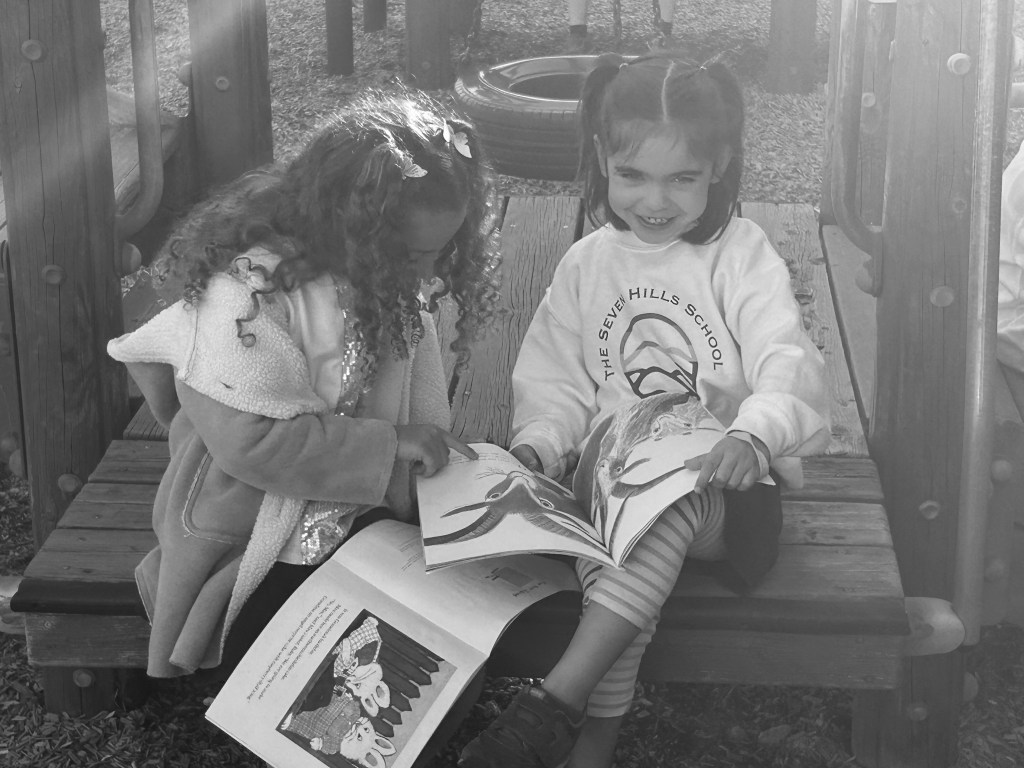
On the road to reading, lower school children should get a balance of direct instruction, individual work time, independent reading time, whole class read aloud, and group work. Typically we think of K-2 age children as learning to read, and after 3rd grade as a time for reading to learn. K-4 classes all have a variation on a small group meeting to share and discover elements of books in community with each other. Different teachers have different names for book group work; guided reading groups, reading with friends, book groups, or book clubs are some of what you may have heard about. In kindergarten children might be discussing how you find the title, front and back of the book, in first grade children might be discussing summarizing a familiar fairy tale, second grade children might be trying to figure out the precise moment in a Cam Jansen chapter book when the mystery was revealed to the reader (comprehension) and in third or fourth grade a book club might be discussing opinions about a particular character and how we might relate to that character or not (some call that making connections, self to text). The focus of instruction is to guide our kids to be active, engaged, self regulating, and flexible readers of many genres.
Explicit time is also set aside in all classes for choice, at every age and stage. Some classes call it DEAR time (drop everything and read), rest and read, or peaceful reading. Some children prefer to read fantasy, while others are happy to peruse, over and over again, the Guinness Book of World records. Parents, you know who you are too-whether you prefer a long lingering poem, or reading baseball stats-being a discerning reader is serious work! Whether just looking at pictures and tracking pages, enjoying a favorite comic book, or diving deep into a hefty novel, time with books has the biggest impact on developing a culture of readers in school, and we make sure kids get plenty of it. No matter what age or stage of reading development your lower school child is at, we give them all plenty of time to choose, and become “thinking” readers.
Here are a few thoughts to help support the development of independent readers at home.
•Autonomy: Give them ownership and a sense of independence. For example, let your youngest ones predict or tell the story they see in the pictures, or decide when to turn the pages when you read with them, (they may be churning something over in their minds that strengthens their endurance as readers.) For older children who are developing fluency as independent readers, try to be open to the books they like; even if you don’t love Diary of a Wimpy Kid, they might, and it will probably pass anyway. You can surely help by exposing them to a variety of genres, but try to appreciate what they like, too.
•’Just Right’ books: For those emerging readers who need lots of practice, help them pick “just right” books-if a book is too hard or too easy, children are not developing their skills, or engaging their minds much. Many kids need guidance in choosing books for practice, since they develop at different rates from their peers. Consider alternating a parent choice and a kid choice. Help emerging readers build strategies for dealing with text. “Sounding out” words is one strategy. When your child asks you to read or spell a hard word, ask them what they know, first, “What is the first sound? Have you seen it before? What clue is in the picture?” Building new vocabulary and genre, and getting stuck on a few tricky words now and then is just about right. Talk about the choices they make, and reflect after about what made it a good, or not so good, choice.
•Read for Meaning: Always read aloud with your kids. Shared reading offers opportunities for conversation about reading, and about life. Model engagement and focus-giving kids a space in your house to cozy up with a good book can go a long way. Reading alongside them can help sometimes too. Talk about the books you read, about mistakes you make, and why you sometimes abandon books. Ask them questions about what they read, about characters, content and vocabulary. We want to develop discerning, self knowing readers, who read for meaning, purpose and pleasure.
Learning to be readers is not something that happens exclusively in a reading group, or while we read to our kids at night. It is a slow and steady development, exponential in its complexity, that is really discovered over a lifetime. Those first years of reading represent a first step towards independence that allows us to really see our children’s future without us-how do they think, what do they like? They begin to develop an inner life as they experience books with their peers, and increasingly, without you. Reading really is an open door to perspective beyond the walls of their world. Today’s emerging first grade readers of Frog and Toad are soon to be holding a novel with epic themes that may make you shudder, but will surely make you proud, too.
 JA Missives
Leave a comment